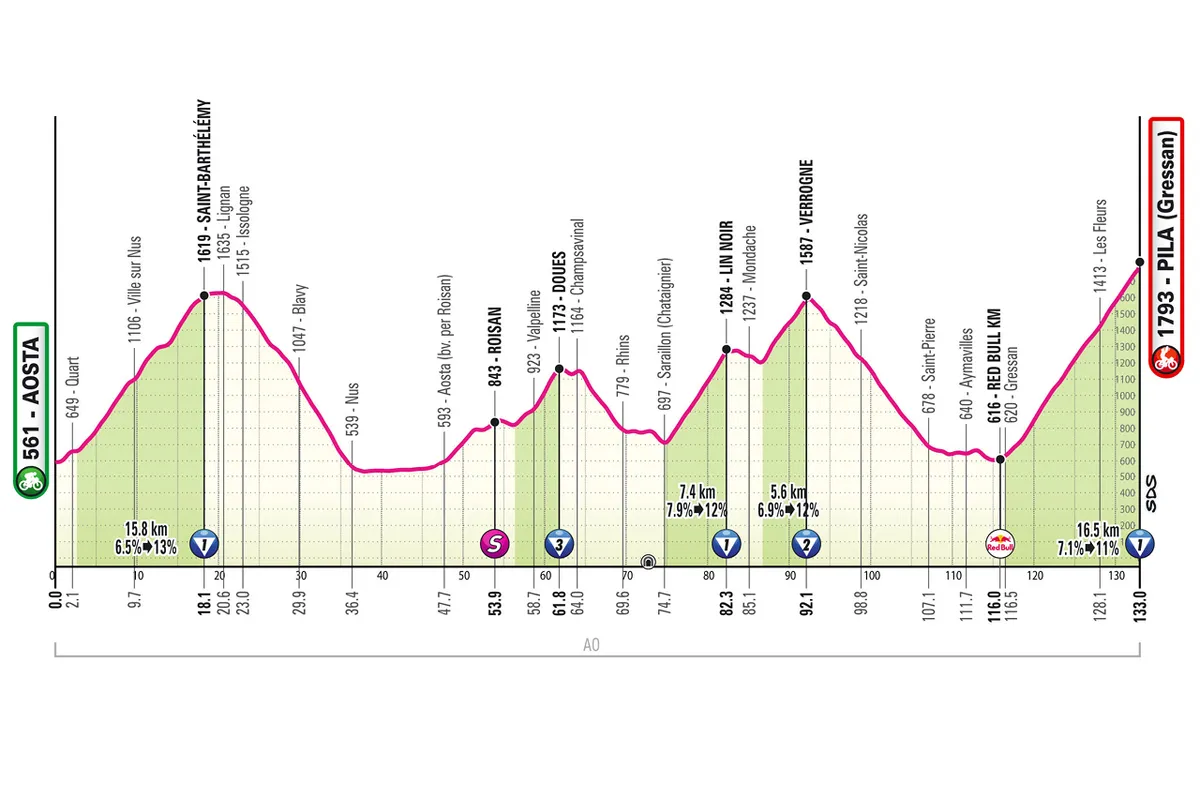
The peloton is set to contest the only mountain summit of the second week at this Giro d'Italia on stage 14 atop the climb in Pila, at 1,793 metres, on Saturday. Starting in Aosta, it will be a short but intense route, 4,350 metres of elevation gain over just 133km of racing, where the general classification will almost surely change hands.
The climb to Pila has been looming large with the peloton starting the second week of racing with a decisive head-to-head time trial in Massa, followed by three hilly stages into Chiavari, Novi Ligure and Verbania.
Afonso Eulálio (Bahrain-Victorious) has managed to hang on to the maglia rosa by just 33 seconds ahead of Jonas Vingegaard (Visma-Lease a Bike) and 2:03 ahead of Thymen Arensman (Netcompany Ineos).
Latest Videos From
Vingegaard and Visma-Lease a Bike are the favourites at this Giro d'Italia, but only recently revealed that the Dane was ill during the first week of racing. He is now fully recovered, and the team are prepared to take the maglia rosa on Pila and carry it into the final week of racing toward Rome.
Asked if there would be a big attack from Vingegaard on stage 14, he said, "It depends on how the legs are, obviously. Of course, if I feel good, it would be nice to go for it."
Vingegaard won the first to summit finishes atop Blockhaus on stage 7 and Corno alle Scale on stage 9. Ben O'Connor (Jayco-AlUla) is currently fifth overall at 2:50 back and expects a different type of racing to Pila than the previous two mountain stages.
"Blockhaus and Pila are not similar at all. [Stage 14] is really up and down with mountains all day, whereas Blockhaus was very long with long drags. It's still a mountain finish but a different way of approaching the stage," he said.
Get The Leadout Newsletter
The latest race content, interviews, features, reviews and expert buying guides, direct to your inbox!
It will be a challenge from the very beginning with a category 1 ascent to Saint-Barthélémy, a 15km climb with an average gradient of 6.1%, but that hits 13% in some sections.
A fast descent won't give stragglers much time to catch back up before the climbing through Valpelline valley roads toward Doues, the category 3 climb being the least demanding of the stage.
The peloton will hit another category 1 ascent at Lin Noir, a 7.4km climb at 7.9% with pitches as steep as 12%, and with almost no reprieve the will face the category 2 Verrogne, a 5.6km climb at 6.9% and steeper sections at 12%.
A look back at the 1987 Giro d'Italia with Philippa York
The Giro d'Italia returns to Pila after a 30-year absence. Philippa York won stage 21 atop the summit in 1987, and Stephen Roche went on to win the overall title.
In an interview with Cyclingnews, York looked back on her victory atop Pila, gave a play-by-play of what led to it, and detailed what made the climb so challenging.
The day to Pila was basically my last chance to win a stage; the next day was the final stage TT, which was really my concern. Two days earlier, I'd been second behind Jean Francois Bernard, and it was a missed opportunity because when the guys asked if they should ride in the valley heading to the last climb, I'd said no because I wasn't sure how I felt. Then, on that climb, I actually had been OK and attacked the GC group. I'd been better than I thought.
By contrast, when we started the 16km climb to Pila, I felt terrible, and with every acceleration, I suffered. Marino Lejarreta kept attacking, and I had to respond, but I was at my absolute maximum each time. He continued attacking until we were about halfway up, and then Roberto Visentini caught my back wheel and crashed, taking Erik Breukink, my teammate at Panasonic, with him. That signalled Stephen Roche to start riding because he could distance Visentini and Breukink, so Roche and Lejarreta swapped turns, and I basically hung on as best I could.
Luckily, this meant the accelerations stopped, and though it was a high pace, I eventually recovered. They asked me a few times to work with them, but I had orders from the team car not to pull as Breukink was 2nd on GC and Lejarreta was likely to pass him. I was happy to sit on. By 3km to go, I was pretty sure I was going to win the sprint because Roche and Lejarreta had tired, but I decided I'd wait until well inside the last kilometre to make sure. At 500 metres from the line, I attacked the other two and had time to celebrate.
It was a seven-hour stage, the longest of the race, and it was probably the day I felt the worst in terms of climbing, but circumstances resulted in me winning.
The first third of the climb I'd found really stifling, long straights between the hairpins meant there was no chance to recover. It was only when the hairpins came quicker that I felt slightly better.
The top of the climb is much more open, and the final bit to the line is straight, wide and pretty steep. It's not an easy sprint. The hardest part was definitely the middle section from about seven to five kilometres to the top. It rode very much like an Alpine climb; the road surface was smooth, and there was not much wind until the final couple of kilometres.
Image 1 of 2
Route profile of stage 14 for the 2026 Giro d'Italia(Image credit: RCS Sport)
Route map of stage 14 for the 2026 Giro d'Italia(Image credit: RCS Sport)
Timings
Start time: 12:55 CET
Finish time: 17:15 CET
Mountains
Saint-Barthélémy (cat. 1, 15.8km at 6.1%, max. 13%), km. 18.1
Doues (cat. 3), km. 61.8
Lin Noir (cat. 1, 7.4km at 7.9%, max. 12%), km. 82.3
Verrogne (cat. 2, 5.6km at 6.9%, max. 12%), km. 92.1
Kirsten Frattini has been the Editor of Cyclingnews since December 2025, overseeing editorial operations and output across the brand and delivering quality, engaging content.
She manages global budgets, racing & events, production scheduling, and contributor commissions, collaborating across content sections and teams in the UK, Europe, North America, and Australia to ensure audience and subscription growth across the brand.
Kirsten has a background in Kinesiology and Health Science. She has been involved in cycling from the community and grassroots level to professional cycling's biggest races, reporting on the WorldTour, Spring Classics, Tours de France, World Championships and Olympic Games.
You must confirm your public display name before commenting
Please logout and then login again, you will then be prompted to enter your display name.